
I remember sitting in a university library one cold evening and reading about Albert Einstein. Before he became one of the most famous scientists in history, he worked as a clerk in a Swiss patent office.
He was not leading a major university department or working inside a large laboratory. He was simply a curious person who continued to ask difficult questions.
At the time, I believed that only senior academics with decades of experience could develop theories. I thought that students were expected to read, understand and repeat the ideas created by more qualified people.
However, the story of the young patent clerk challenged that belief.
You do not need a PhD before you can develop a theoretical idea. A PhD (Doctor of Philosophy) can provide advanced training, research experience and a deeper understanding of a subject, but it does not give someone exclusive permission to ask questions or propose explanations.
Theory development begins with curiosity, observation and logical thinking. These are abilities that students, professionals and ordinary people can also develop.
However, building a theory is not the same as making a random guess. A theory must offer a clear explanation, connect ideas logically and be open to testing. Let us look at how the process works.

What a Theory Actually Is
A theory is a structured explanation of how or why something happens.
Imagine that you notice that some students perform poorly in online classes even though they have access to the internet, suitable devices and learning materials.
The observation alone is not a theory. It is simply a pattern that has attracted your attention.
You may then ask:
Why are these students struggling when they appear to have everything they need?
A theory begins to develop when you propose an explanation for the pattern and show how the different parts of the explanation are connected.
For example, you may suggest that students who attend online classes in noisy homes find it difficult to concentrate. Reduced concentration may affect their participation, understanding and academic performance.
The explanation contains several connected ideas:
. noise in the home;
. concentration;
. participation;
. academic performance.
A theory does not merely identify these ideas. It explains how one may affect another.
Step One: Notice a Pattern or Problem

Many theories begin with something that does not seem fully explained.
You may notice the pattern through personal experience, observation, interviews, reading or previous research. Perhaps you have seen students with good internet connections and modern devices still struggle during online lessons.
You may also notice that existing explanations focus mainly on internet access, digital skills and teaching quality.
The situation may lead you to wonder whether researchers are overlooking the physical environment in which students attend their classes.
Your first task is not to produce a perfect explanation. It is to identify something worth explaining.
A useful starting question is:
Why does this happen when the existing explanations suggest that it should not?
The question turns an ordinary observation into a possible research problem.
Step Two: Read What Other People Have Said
You do not normally build a theory from nothing. You build on what is already known.
Read studies, books and reports related to the problem. Find out how other researchers have explained it. Look at the factors they studied, the conclusions they reached and the questions they left unanswered.
Suppose you read several studies about online learning. Most of them discuss internet quality, digital devices, teacher support and students’ computer skills. However, very few examine noise, frequent interruptions or overcrowding in the home.
The missing area may be your gap.
A gap does not always mean that nobody has ever discussed the subject. It may mean that:
an important factor has received little attention;
an existing theory does not explain a particular situation;
previous studies have produced conflicting findings;
a known explanation has not been tested in a certain setting;
two ideas have been studied separately but have not been connected.
Finding a gap helps you avoid repeating what is already known. It also shows where your explanation may add something useful.
Step Three: Identify the Main Concepts
Once you find the gap, identify the main ideas in your explanation.
In the online-learning example, the main concepts may include:
environmental distractions;
concentration;
class participation;
academic performance.
The concepts must be clear. A reader should understand what each one means.
For example, the phrase “home environment” is too broad. It could include lighting, furniture, family support, electricity, noise and room temperature.
You may therefore narrow it to “environmental distractions,” which could include loud conversations, television sounds, frequent interruptions and a lack of private study space.
Clear concepts make a theory easier to understand and test.
Step Four: Explain How the Concepts Are Connected
The next stage is the most important part of theory development. You must explain the relationships between your concepts.
You may propose that:
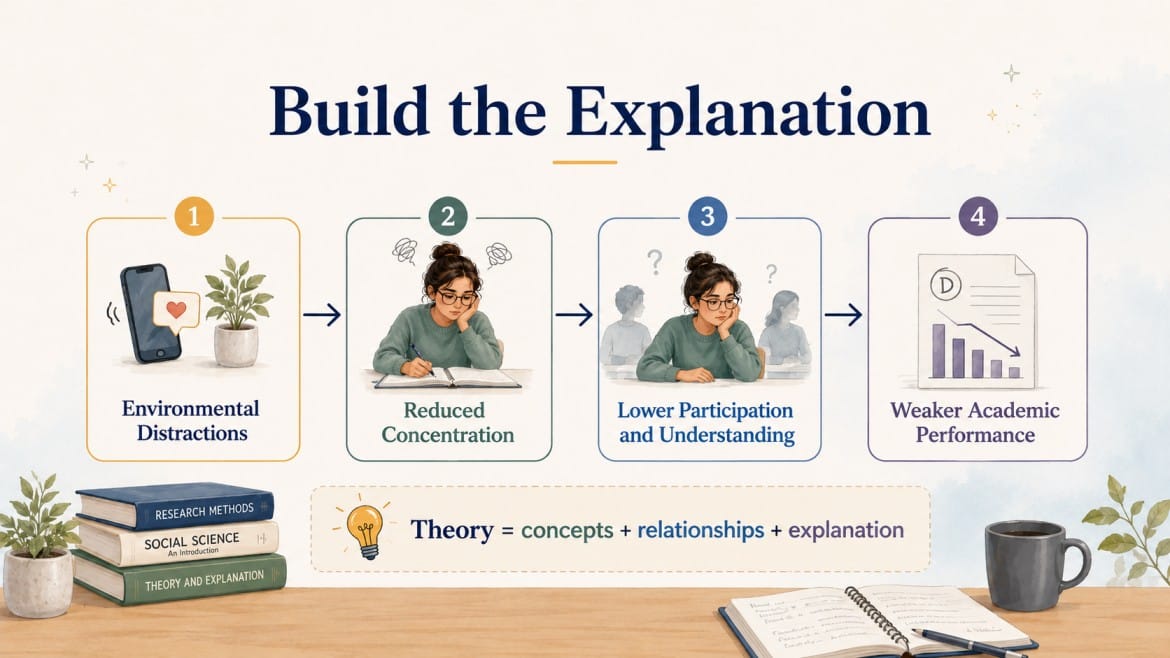
Environmental distractions reduce a student’s ability to concentrate during online lessons. Reduced concentration lowers participation and understanding, which may eventually affect academic performance.
The statement is beginning to look like a theory because it describes a process.
The relationship can be presented in a simple form:
Environmental distractions → reduced concentration → lower participation and understanding → weaker academic performance
The middle part of the explanation is important. Without it, you may know that two things are related, but you may not understand why.
A useful theory should answer questions such as:
What causes the problem?
What happens next?
Why does one factor affect another?
Is there a middle factor that explains the relationship?
Are there conditions that may make the effect stronger or weaker?
Step Five: Explain Why the Relationship Should Exist
You must now explain why the proposed relationships make sense.
Why should noise affect concentration? Why should concentration affect academic performance?
You may draw on existing research about attention and learning. Human attention is limited. When a student listens to a lecturer while also dealing with conversations, television sounds or frequent interruptions, the student’s attention becomes divided.
Important information may be missed, and the student may struggle to follow the lesson.
The explanation gives your theory a logical foundation.
At this stage, you are not claiming that the theory is certainly correct. You are showing why it is reasonable enough to be investigated.
Step Six: State Where the Theory Applies
A theory may not work in every place, situation or group. You should therefore explain its boundaries.
Environmental distractions may strongly affect students who attend live online classes from shared or crowded homes.
The effect may be weaker among students who have private rooms, use noise-cancelling headphones or can watch recorded lessons later.
You may therefore state that your theory applies mainly to students who attend live online classes in environments where they have little control over noise and interruptions.
Setting boundaries does not weaken a theory. It makes the explanation more precise.
A theory that tries to explain everything may end up explaining very little.
Step Seven: Turn the Explanation into Testable Statements

A theory must produce claims that can be examined using evidence.
From the online-learning theory, you could develop statements such as:
Students who experience more environmental distractions will report lower concentration.
Students with lower concentration will participate less in online classes.
Lower participation will be associated with weaker academic performance.
Access to a private study space will reduce the negative effect of environmental distractions.
These statements are hypotheses.
A hypothesis is a specific prediction that comes from a theory. The theory provides the wider explanation, while the hypotheses allow you to test different parts of it.
Step Eight: Gather Evidence
The next step is to examine whether evidence supports the explanation.
Depending on the subject, you may use surveys, interviews, experiments, observations, academic records or existing datasets.
In our example, you might ask students about the level of noise and interruptions in their homes. You could also measure their concentration, class participation and academic results.
The purpose is not to search only for evidence that agrees with you. You must also consider evidence that challenges the theory.
Perhaps the results show that noise affects concentration but does not always affect academic performance. You may discover that recorded lessons allow students to recover what they missed.
The finding would not necessarily destroy the theory. It may help you improve it.
Instead of claiming that environmental distractions always lead to poor performance, you may conclude that the effect depends on whether students can review recorded lessons.
Good theory development requires honesty. You must follow the evidence, even when it does not support your original idea.
Step Nine: Let Other People Challenge the Theory
Share your explanation with classmates, tutors, researchers or people who understand the subject.
Ask them questions such as:
Are the concepts clear?
Does the explanation make logical sense?
Is an important factor missing?
Could the pattern have another explanation?
Can the relationships be tested?
Are the boundaries of the theory clear?
Criticism may feel uncomfortable, especially when you have spent a long time developing an idea. However, people who question the theory may help you notice weaknesses that you missed.
A theory becomes stronger when it survives serious questions. It may also become more useful when criticism leads you to revise it.
Step Ten: Revise the Theory
The first version of a theory is rarely the final version.
Research may show that some relationships are weak, some concepts are unclear or some important factors are missing.
The original idea may be:
Noise in the home causes students to perform poorly in online classes.
After reading, testing and receiving feedback, the theory may become:
Environmental distractions can reduce concentration during live online lessons. Reduced concentration may affect participation and understanding, although access to recorded lessons and private study spaces may reduce the negative effect.
The revised version is more detailed, careful and realistic.
The theory has improved because it has been questioned and tested.
Why You Do Not Need a PhD to Begin
A PhD does not create curiosity. It does not automatically make every idea correct, and it does not prevent a researcher from making mistakes.
Advanced academic training can provide knowledge of research methods, greater familiarity with existing studies and more experience in testing ideas. These skills are valuable, but they can be learned gradually.
You can begin developing a theory when you are able to:
notice a pattern that needs an explanation;
read what is already known;
identify what may be missing;
define the main concepts;
explain how and why they are connected;
test the explanation with evidence;
revise the idea when necessary.
You may need guidance from experienced researchers. You may also need more reading, stronger research skills and better evidence before your theory gains academic acceptance.
However, none of these requirements means that you must wait until you earn a PhD before you begin thinking theoretically.
A qualification may improve your ability to develop and defend a theory, but curiosity and logical thinking come first.
Start with a Small Explanation
You do not have to begin with a theory that explains the entire world.
Start with a small problem in an area you understand. Look for a repeated pattern. Ask why it happens. Read what others have said. Identify what may be missing and connect the ideas in a way that can be tested.
Your first explanation may be incomplete. It may be criticised, changed or even rejected. That is part of the process.
Theories do not appear fully formed in the minds of extraordinary people. They grow from questions, evidence, discussion and repeated revision.
You do not need a PhD to ask a meaningful question or propose a logical explanation. You need curiosity, careful reasoning and the willingness to test whether your explanation is actually true. You may also be interested in knowing the differences between PhD, MPhil, MA and MSc. Click to Read

Godson Nana Adu Agyei has over eight years of experience in research consulting and study design. At NurcAcademy.com, Godson applies his extensive practical experience to help students, academics and professionals understand the intricacies of research methodologies. From developing powerful research questions to conducting complex data analysis, he provides high quality, practical tutorials that bridge academic theory and real-world practice.