
Do you know that one of the biggest struggles students face is not the research itself, but the way that they write about it? Several years ago, I sat at my desk looking over a draft from a very bright postgraduate student. He had designed a brilliant experiment, but his supervisor had covered his methodology chapter in red ink. The problem was not his science. It was his grammar. He kept mixing up the things that he was going to do with the things that he had already done.
This is a trap that many of us fall into. We spend so much time on the process that involves planning our research that we forget to shift our language when the work is finally complete.
The Golden Rule of Timing
To perfectly write your research methodology, you must first ask yourself a very simple question. Do you want to submit a proposal, or do you want to submit the final thesis? The answer to this question determines everything about your writing approach.
If you prepare a research proposal, you are essentially pitching an idea. You are telling your committee or your funding board about the things that you plan to do. Because the events have not happened yet, you must use the future tense. You will use statements like, "I will collect the data using a survey," or "We will interview fifty participants." This approach shows them the clear path that you intend to take.
On the other hand, if you present your final research paper, dissertation, or manuscript for publication, the situation changes entirely. At this stage, the research is a finished event. You have already collected the data, and you have already analysed it. Therefore, you must write the methodology in the past tense. You are reporting on actions that you completed in previous months. You will write statements like, "I collected the data using a survey," or "We interviewed fifty participants."
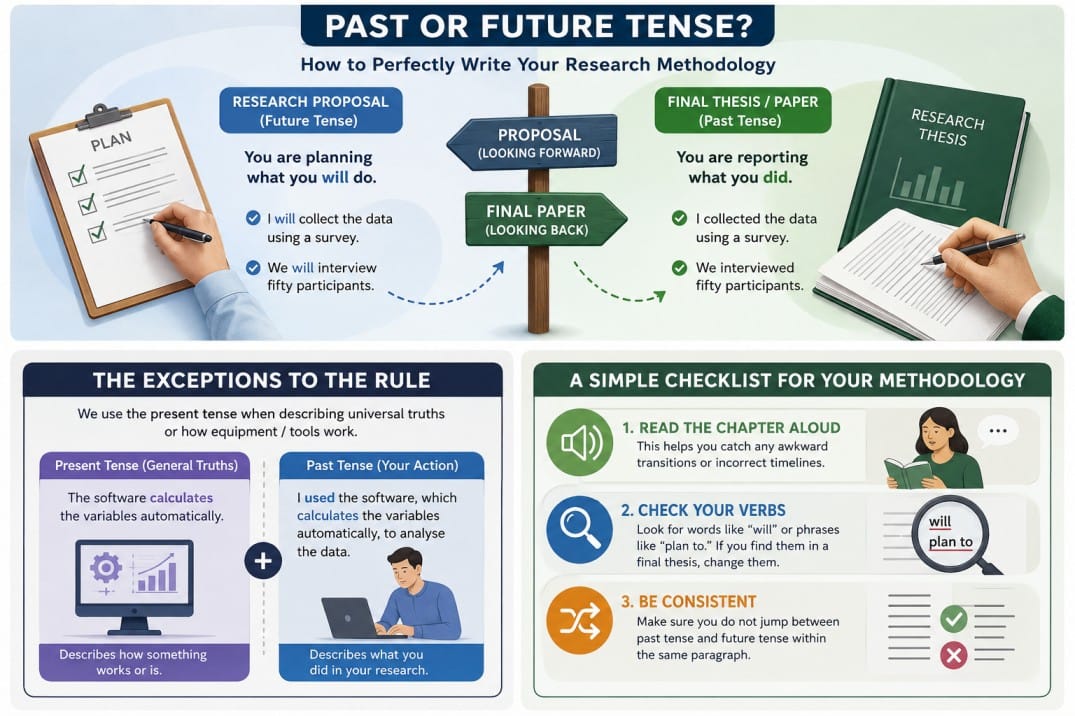
Why the Past Tense Matters for the Final Paper
Many students usually struggle with this transition. They copy texts from their proposal and paste them directly into their final thesis to save time. However, the habit that involves leaving your final methodology in the future tense confuses the reader. It makes them wonder if you actually completed the work or if you are still just planning it.
When you write in the past tense, you build trust with your audience. You show them that the steps that you describe are historical facts. You give a step-by-step account of exactly what happened, which allows other researchers to replicate your work. If another scientist wants to test your results, they need to know what you actually did, not what you thought you would do.
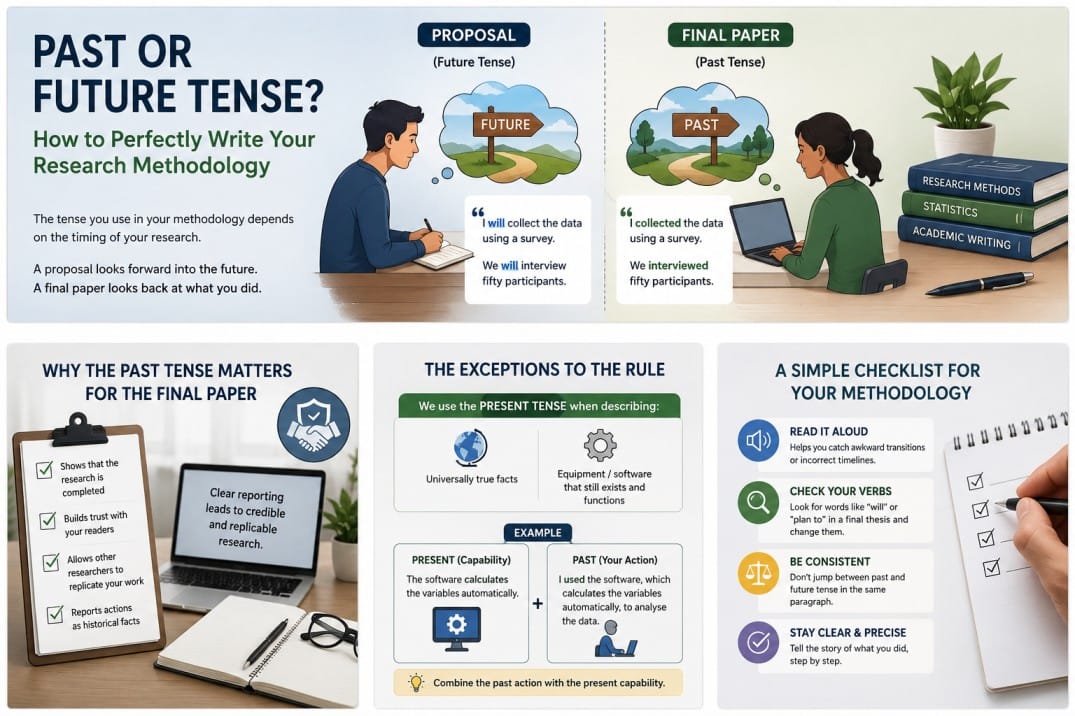
The Exceptions to the Rule
While the past tense is the standard for a completed methodology, there are a few minor exceptions that you should know. Sometimes, you might need to use the present tense.
Key Insight: We use the present tense when we describe facts that are universally true or when we detail equipment that still exists and functions in a specific way.
For instance, if you explain the way that a specific software programme works, you might say, "The software calculates the variables automatically." You use the present tense here because the software still does this today.
However, the specific actions that you took with that software must remain in the past tense. So, you would write, "I used the software, which calculates the variables automatically, to analyse the data." Notice the way that we combine the past action with the present capability of the tool.
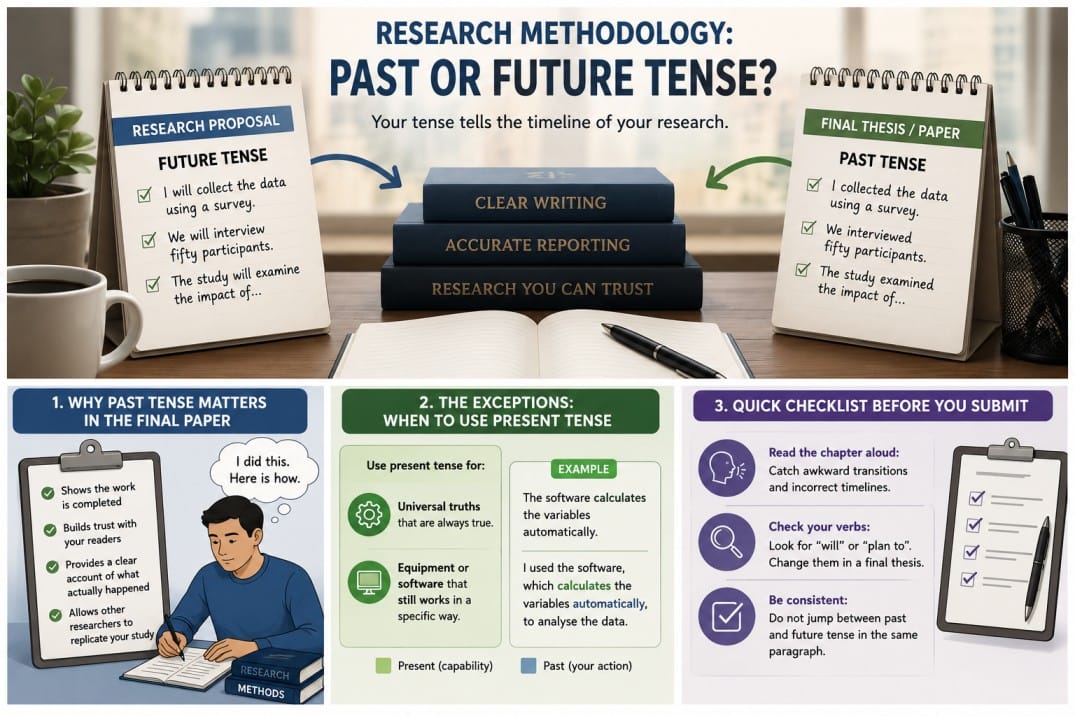
A Simple Checklist for Your Methodology
To make sure that your writing is flawless, I recommend a simple strategy before you submit your work:
Read the chapter aloud: This technique helps you to catch any awkward transitions or incorrect timelines.
Check your verbs: Look for words like "will" or phrases like "plan to." If you find them in a final thesis, change them immediately.
Be consistent: Make sure that you do not jump between the past tense and the future tense within the same paragraph.
The task that involves writing a methodology chapter does not have to be an overwhelming ordeal. By understanding the timeline of your research, you can easily choose the right tense. Remember that a proposal looks forward into the future, while a final paper looks back into the past. Keep your writing clear, tell the story of the things that you did, and you will guide your readers smoothly through your research journey.

Godson Nana Adu Agyei has over eight years of experience in research consulting and study design. At NurcAcademy.com, Godson applies his extensive practical experience to help students, academics and professionals understand the intricacies of research methodologies. From developing powerful research questions to conducting complex data analysis, he provides high quality, practical tutorials that bridge academic theory and real-world practice.