

Have you ever read a blog post or an email and immediately knew a machine wrote it? You are definitely not the only one. We are currently watching one of the biggest technology races in history as different companies release new AI language models. Most people expect that the model that sounds completely human or humanised and is indistinguishable from human writing will easily win the race.
However, that is not exactly what is happening behind the scenes. If you look closely at the recent updates from major tech companies, they are focusing heavily on adding new technical features instead of making their AI sound like you or me or simply producing texts that are humanised. They are adding voice modes, image generation, and better coding abilities. There is a very specific reason for that approach.
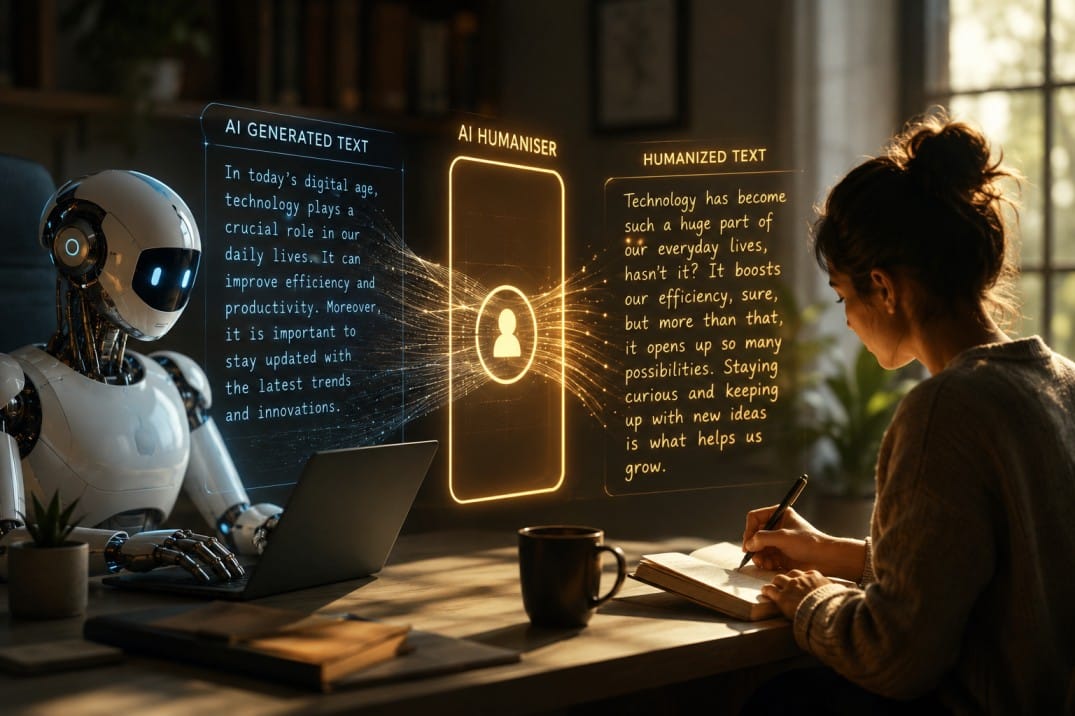
The Role of AI Humanisers
Because major AI models write in a very standard and predictable way, a whole new software industry has emerged. We now have tools known as AI humanisers. These are separate applications that people use to rewrite AI-generated text to make it sound natural and less robotic. Their basic aim is to take AI-written texts and make them humanised.
The existence of these tools proves a simple point. Users desperately want text that sounds like a real person actually sat down to write it. We want the slight imperfections, the conversational tone, and the natural warmth that machines usually lack. Despite the clear demand from users, the companies building the big foundational models are not rushing to fill the gap.
Why AI Language Models Are Not Trying to Sound Like Humans
You might wonder why multi-billion-dollar companies are ignoring such a huge demand for human-like writing. The answer comes down to how these systems are designed to operate in the real world. Here are three reasons why AI language models are not in a hurry to write like humans.

1. Safety and Predictability Are the Main Goals
First, tech companies want their language models to be completely safe for the public to use. When a model writes like a human, it naturally takes on personality traits, emotions, and sometimes even opinions. Such behaviour introduces a lot of risk for a big tech brand.
A machine that mimics human emotion might say something offensive, or it might confidently share a biased opinion. An incident like that would cause massive public relations issues for the company. Therefore, developers train these models to be entirely neutral, polite, and highly predictable. The robotic and repetitive tone you read is actually a built-in safety mechanism that keeps the AI from crossing social boundaries.

2. A Focus on Broad Capabilities Instead of Creative Writing
Second, tech companies do not see these language models as just simple writing assistants. They are building general-purpose tools that can perform many different tasks at once. They want the AI to write complex computer code, solve difficult mathematical problems, and analyse large amounts of data accurately.
When you train a model to be an expert at logical and analytical tasks, the language it produces naturally becomes very structured and formal. Giving the AI a quirky or highly relatable human voice takes engineering resources that companies would rather spend on making the model smarter and faster. They want a machine that can do a bit of everything well, rather than a system that is just a perfect conversationalist.
3. The Need for a Universal Voice
Third, these language models have a massive global user base. A true human writing style is deeply tied to culture, local slang, and specific life experiences. If an AI writes with the distinct personality of a British teenager, a business executive in Japan might find it completely inappropriate for a professional setting.
To appeal to the widest possible audience, developers programmed the models to use a universal and flat voice. The voice is designed to offend no one and work in almost any situation. It works in a formal corporate email just as well as it works in a basic school essay. A distinct human personality would simply restrict who can use the tool effectively across different countries and industries.
The Future of AI Writing
The AI technology race will definitely continue to produce faster and smarter models in the coming years. But we should not expect them to sound like our favourite authors anytime soon. As long as tech companies prioritise safety, technical features, and global appeal, that familiar robotic tone will remain with us.
Consequently, human writers still have a very clear advantage in the digital space. Until the foundational models change their core priorities, human writers and AI humanisers will keep their jobs.

Godson Nana Adu Agyei has over eight years of experience in research consulting and study design. At NurcAcademy.com, Godson applies his extensive practical experience to help students, academics and professionals understand the intricacies of research methodologies. From developing powerful research questions to conducting complex data analysis, he provides high quality, practical tutorials that bridge academic theory and real-world practice.